Showing posts with label Burda. Show all posts

Saturday, July 5, 2014

Summer is for easy projects


At long last, my poppy-print version of Burda 4-2014-124 is done. Let me say right here that my next few projects are going to be purposely simple. Or at least not ridiculously complicated.

I do love this poppy fabric. You can read in this post how I fell hard for it . . . but, man, was it difficult to work with. Seam allowances that frayed almost to the seamline before I could get to them, little shredded areas that materialized if the fabric so much as hung over a corner of my cutting mat—this one had me gnashing my teeth. Well, not literally, but you know what I mean. Okay, enough with the qualifications.

I think I might be able to wear this dress in real life if I just sit quietly in a corner somewhere.

The pattern itself is a good one, though not a quick make. There is a complete underdress (same pattern pieces for the six-gore skirt, different pieces, including spaghetti straps, for the bodice) sewn inside the outer dress. With the French seams that I used throughout, this meant a lot of sewing and pressing. Looking at the photo above, seems I need to press that left front skirt seam a little better, ahem.

If you look closely at this next photo, you can see how the finest sewing-machine needle I have, which I changed out several times during this project by the way, still left little "bites" in the fabric.


I made a number of changes to the pattern. For one, I lengthened it by over two inches (but compare to the magazine photo; I'm sure that model is at least as tall as I am??). More important, I left off everything that I thought of as frippery. Frilly details just do not work well on me, so I substituted a simple edging for the piping, and omitted the lace on the underdress bodice, the topstitched batting under the neckband, and the shirring on the sleeves (in fact, I ended up leaving off the sleeves entirely and finishing the armholes with bias binding). I do feel that the part of the underdress bodice that peeks out looks a little plain, so maybe keeping the lace trim there would have been good.

Here's how the neckband looks up close with my changes:


Again because of the fragile nature of the fabric, I had a heck of a time figuring out a way to hem the skirt without it falling apart on me as I went. I ended up using my serger to make a rolled edge, and I'm happy enough with it.


Nature notes:

Photos are from last month, so not brand new, but I still want to give these turtle mamas a little appreciation. This sweet painted turtle was laying her eggs in our front yard one day in early June.


And she brought her sister along to lay her eggs!


The same day, as I walked down the driveway to get our mail, I came across this snapping turtle looking for a good egg-laying place. She is much bigger than the painted ones, like a large dinner plate, and can easily take off a finger if you're silly enough to present it to her.


GO TURTLES!

Saturday, May 3, 2014

Liebster and a little roundup

Back from Japan, and we had such a good time.


While we were gone, Nancy D, of Sewing in Surf City, very kindly nominated me for a Liebster award.


Thank you, Nancy! I grew up outside of Salinas, California, not too far from Nancys town of Santa Cruz, which my friends and I sometimes used to visit for a fun countercultural experience back in the day.

Nancy set a few questions for her nominees:

Do you have a current challenge you are hoping to master to improve your sewing?

Fitting. The method I use now, if it can be called that, is to make a muslin and then haphazardly tweak here and there, without really knowing what Im doing, until the fit seems acceptable. I know there are systematic and effective ways of accomplishing good fit, but I have not yet managed to tap into any of these. My library includes Fitting and Pattern Alteration by Liechty and Pottberg, Pattern Fitting with Confidence by Nancy Zieman, and other fitting books, and I have considered getting Kenneth Kings DVD set on fitting. But somehow I get lost amidst what seems like a lot of confusing or even contradictory information. What I think I need to do is choose a class or book and commit to working through it. Id love to hear what has worked for other people.

What is your motivation for sewing?

I love the doing part of sewing. Sometimes I get hung up in the planning stage (overthinking my pattern and fabric choices) and sometimes I dont quite reach the wearing stage (many of the garments Ive made hang in the closet—Im happy to see them there but I dont pull them out and put them on). But I always enjoy the craft of sewing itself: handling the fabric, cutting, stitching, pressing, handsewing . . .

What do you like to sew best?

Mostly tops, skirts, and dresses. I enjoy making patterns that include a little something different—maybe an unusual shape or construction technique.

Do you have a favorite pattern company?

I have had some good successes with patterns from Burda magazine. Vogue patterns work well for me, too, provided I take their large amount of ease into account. I especially like some of Vogues designer patterns for their interesting and unusual construction and techniques (Ralph Rucci!). I've made a couple of patterns from the Japanese pattern book Shape Shape by Natsuno Hiraiwa, and I look forward to trying more.

Do you have a favorite sewing trick that you think everyone should know?

Well, this is more of a general approach than a trick, and I suspect that everyone else already knows this, but it took me a while to discover. I used to think that getting better at sewing would mean I'd sew more quickly and with less effort, but its just the opposite. For example, hemming is usually a multi-step process now: put in two rows of machine basting, fold and press along those rows of basting, baste a third time to hold in place, topstitch or hem by hand, remove all basting. It takes longer than what I used to do—press folds in, stitch—but the result is so much better.


Me-Made-May 2014 is on! I only have two days worth on the Flickr page (my pledge was to wear something Ive made five days a week, and we just started on Thursday), but Im still going to do a mini roundup and evaluation.


Top, Vogue 8535: More wearable than I thought. I just finally posted a pattern review of this.


Dress, Burda special issue from 2000: The fit is not bad, but the length is off. I could shorten it, but there are five topstitched overlapped vents around the bottom hem and it would be a lot of work, for a dress that I probably still wouldnt wear much. (The theme this day was cocktail hour.)

Saturday, April 5, 2014

Pretty poppies

Lots of photos ahead; if you don't like poppy prints, look away now.

In mid-March, my husband and I made a quick weekend trip to New York. (Digression: I love our house in the woods of New Hampshire, but I lived in NYC from 1986 to 1992 and have never really gotten over it. At least once a week I have a sweet dream in which I find myself living there again. Visiting every now and then makes me very happy.) We packed a lot into a day and a half: the Trend-ology and Fashions of the 1930s exhibits at FIT, Charles Marville's photographs of Paris at the Met, a Broadway play in previews, gallery hopping in Chelsea, an absinthe at a tavern on St. Mark's Place, some real Chinese food, and . . . a trip to Mood Fabrics, of course.

My plan was to find a soft cotton print, maybe a floral, for Vogue 1350. I looked with no special color or print in mind, thinking I would just know it when I found it, and then, bam, there it was. I could feel the tag tucked way down inside the tube and got my husband with his long fingers to fish it out. Turned out that was the wrong end of the tube—no price or content information, just a small brown piece of paper with Oscar de la Renta printed on it.


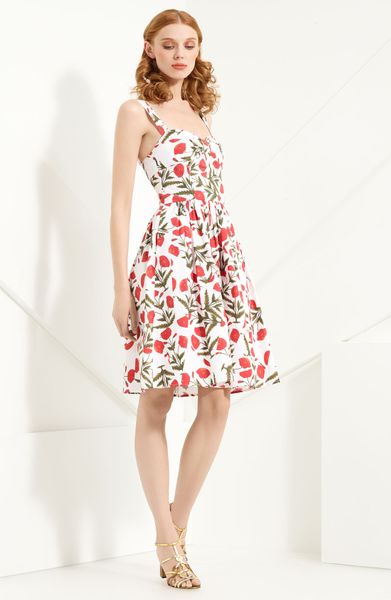
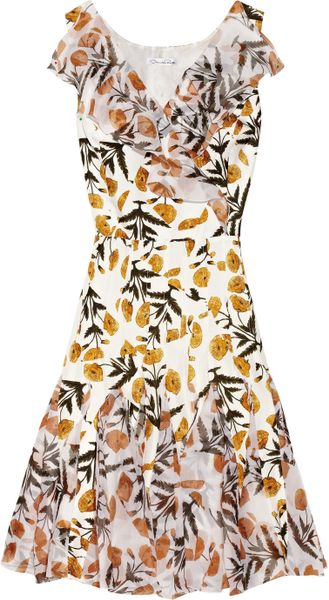
So later, at home, I searched for Oscar de la Renta poppy print online and found my exact fabric made up into dresses.


Well, maybe not my exact fabric. The red print dress is in cotton stretch, and the yellow is silk twill. My fabric is a cotton/silk blend, no stretch. With the information that these dresses were from 2012, I looked up de la Renta's spring 2012 fashion show, and there was my exact fabric again.


Okay, again, not so exact, but it's the same general idea. Let's take a closer look:


Can you see that the leaves are appliqued/embroidered, and the poppies have frills sticking out around the edges? What I bought seems to be one of several "flat" versions of this gorgeously intricate three-dimensional fabric. I'll take it!

I cut a square and gently, gently squeezed some mildly sudsy water through to see how it would react. It didn't shrink, but look at the fraying on those edges. Since it is such a lovely fabric, I will call it fragile rather than flimsy.


My muslin of V1350 came out nicely but on the snug side. (I usually go down a size in Vogue because of the large amount of wearing ease but didn't do so this time; when they say "close-fitting bodice" they mean it.) I've decided to save this pattern for a sturdier fabric that can hold me in where I need to be held in, haha! Seriously, I thought the poppy fabric would work better in a dress with more flow to the skirt, so I'm going instead with #124 from the April 2014 Burda magazine.


My version will omit the batting, piping, lace edging, and the shirring on the sleeves, as ruffles and frills just do not look right on me. I'm still agonizing over experimenting with replacements for the sleeves. Same pattern piece but droopy instead of shirred? Little half-moon cap sleeves? Two-piece short sleeves cadged from another pattern? Leave the sleeves off altogether? I'll need to tone up and tan my arms; fortunately my last post worked and spring has showed up.


A nature/garden note:
This snap out my sewing room window shows why we will have very few flowers this spring. The azaleas and rhododendrons have lost all their tips; even the crocuses are just nibbled stubs poking from the ground. I haven't been able to bring myself to shoo this group of three does and two teenage deer away often enough (especially because one of the does has only three legs), and they have taken up residence. Disaster for the garden.


Friday, January 3, 2014

Goals for 2014 and a skirt from 1999


Poor blog, left to languish all through November and December. I have in fact been sewing, just not posting. There are a few things to show once I manage a photo session or two. In the meantime, I've been thinking about my sewing goals for 2014.

Some of the goals are kind of general:

-Improve my technique. This is a perennial goal, and I am slowly improving, but I could work a little harder on this. How about zippers, invisible and otherwise? Why do they still make me nervous? If I just buckle down and do a whole bunch of them, surely they will lose their scary power. Welt pockets? I tried to follow instructions for them once and had a hard time -- but I've done a lot harder things in my life, time to try again.

-Sew more to my personal style. My usual scattershot approach -- what a great fabric, oooh this pattern looks interesting -- too often leads to a kind of mishmash of garments that can't be worn with anything else and don't even look like me. I'd like to be more thoughtful about making clothes that will fit well into my closet and that I will pull out to wear because they just feel right.

-But at the same time that I'm being more thoughtful about my choices, I'd like to sometimes have more fun sewing. Experiment more, let loose, try lots of things knowing that some of them won't work and not worrying about it too much. It's just fabric, and time. For example, I've had the Pattern Magic books for over a year now and haven't tried anything. What have I got to lose? It might be fun.

So all of the above are things I have worked on and will keep working on. But there are two areas in particular that I want to focus on this year, ones that I think are essential in order to improve my (sewing) life, not to be overly dramatic about it.

-Get more comfortable with blogging, which is to say, get more comfortable with taking and looking at photos of myself. I love the fact that there is this sewing community out there and I want to be a part of it. I am inspired and uplifted by the blog posts I read and the interactions I see. Aargh, why let silly self-consciousness get in the way?

-Learn how to fit my clothes better. I so often find that the fit of what I sew is off; my body is no longer the youthful, out-of-the-envelope shape that I like to think it once was. It's time to learn what needs to be done. Somehow this has stymied me, with all the different approaches out there. I have bought the Craftsy class Fast-Track Fitting with Joi Mahon and will start that soon. The book Fitting and Pattern Alteration is in my library; my first glances at it have left me with more questions than answers, but I will make a project of working through it this year. I would welcome some hands-on help, but I haven't found anything closer than Boston, and driving down there regularly will have to wait until winter ends.

In the meantime, to get some photos into this post, I've found some old pictures of an even older Burda skirt pattern I've made up twice. Yeah, it's from 1999. I loooooove this pattern. Here is my review of it from a few years ago. It has a nonbulky, no-waistband waist, and the O shape, as Burda calls it, works for me.


I may yet turn this into a TNT by making it up in some of the many skirt-suitable fabrics in my stash. The shape is even more outdated now than when I first made it, but by my reckoning it's due to come around again as a trend any time now. And then I'll be ahead of the game, right?


Fun things to do in the northeastern U.S.:
Quick, go see the exhibit Future Beauty: Avant-Garde Japanese Fashion before it closes on January 26. It's at the Peabody Essex Museum in Salem, Mass. Really, it's very interesting, and much more extensive than I expected. No photography was allowed, sadly, so I can't show you anything here. Some of the clothes are just plain . . . weird. But some of them feel like epiphanies. The very best part is that there is a rack of clothes by various designers for museum visitors to try on.

Happy new year to all!

Tuesday, October 22, 2013

A task to gladden a Virgo's heart


Thread tracing!


Look closely to see the chartreuse stitches around the edge of the pattern piece.

This is not the machine tracing that is sometimes done on a muslin, but hand thread tracing that you do right on the fashion fabric to mark stitching lines and grain lines, as described in Part 2 of the Little French Jacket Sew-along. (An explanation of the distinction between the two types of thread tracing by Coudremode helped remove my little bit of confusion about it.)

Performing this step in the construction of the jacket definitely checked off some of my boxes. Come up with an excuse to buy gorgeous silk thread in several bright colors (check!). Learn a sewing skill whose existence had not even occurred to me before (check!). Get to hang out downstairs with my husband and son, and a glass of wine, while making progress on a sewing project (check!).


The pattern I'm using is Burda magazine 02-2013-107, a Chanel-type jacket with a V-neck and a curved hemline.


My fabric is a wool tweed bouclĂ© from Gorgeous Fabrics: black with plenty of blue and gray and some flecks of off-white, green, and ochre. Very soft and pretty, not nearly as "carpet looking" as it somehow comes across in the photographs.


I'm very much enjoying this sew-along. Next up is quilting the lining to the fashion fabric, another new-to-me skill.


A reminder about roasted vegetables, so good at this time of year, at least for those of us in the colder parts of the northern hemisphere: Cut up some of your favorites (here, it's sweet potatoes and turnips, soon to be joined by chunks of onion and celery), douse with olive oil, sprinkle with salt and any herbs you like, and roast in a hot oven until caramelized and delicious.


How's that for getting some color into this otherwise monochromatic post?


Monday, June 24, 2013

Burda 09-2009, #121, the long-delayed skirt


I liked the look of this skirt right away when this issue of Burda showed up, um, almost four years ago, but it has taken me until now to get around to making it. It's a great basic skirt: fitted at the waist, full and forgiving through the hips, easy and quick to make but with lots of pleats (two kinds) so you feel as if you are doing something.


The waistband runs a little loose. My waist and hip measurements are toward the upper end of Burda size 42, but the waistband slides down as I wear the skirt. I was focused on whether the skirt would be too small, rather than too big, so I completely missed this until I had already put in the zipper and sewn on the waistband. As another PR reviewer mentioned, the fullness of this skirt feels best when the waist stays snugly where it's supposed to be. The good news is that the pleats are in the same position for all the sizes, so you can put all the pleats in place and then decide how much seam allowance to go with on the sides.


And as for the seam allowance at the top of the front and back: don't bother adding it when you trace off the pattern in the first place. One of the first things you do after getting the pleats in is "Cut off seam allowance at upper edge of skirt." Yes, really. And the bias strip for the waistband? Allowances are already included in the measurements given. So if you really hate adding seam allowances to Burda magazine patterns, this is the skirt pattern for you.


We've got knife pleats in the front


             and box pleats in the back.


My fabric is a charcoal corded cotton from Fabric Mart, sturdy but surprisingly lightweight. (The top picture is closest to the actual color. It's neither light gray nor steel blue, despite what some of my photos show.)


The instructions are clear, and I suspect many sewists wouldn't even have to use them (though I can't keep myself from reading any and all instructions; I blame it on my former life as a copy editor). I did stitch in the ditch (I stitched in the ditch?) instead of edge-stitching on the waistband, and I hemmed the skirt by hand. The invisible zipper is not perfect, but we're getting there . . .


    Happy me.


The PR review is here.


Audio files:

Listening to Johnny Flynn and Laura Marling, separately, though they're also very good together, as you can hear here.

Wednesday, June 5, 2013

Burda 06-2013, #119, and what I hope is the seam method of pattern alteration

I have a new blouse!


It's a pretty simple one. The point of making it was to experiment with fitting. I would clearly benefit from a full bust adjustment -- many of my tops are either too loose at the shoulders or too tight through the bust -- but I've muddled along without knowing how to do one for a long time.

I don't think the method I used is a common one, but I'm pretty happy with how it came out. It's the seam method from the book Fitting and Pattern Alteration, recommended by Susan Khalje in the Craftsy course I'm working my way through. At the risk of overreaching here as a brand-new blogger, I'm going to try to summarize it, only because I didn't find much about this method online. So just skip this part if you want, obviously.

If I understand the basics of this method correctly (and that's a huge IF; this was not at all easy for me to figure out so please point me toward better information if you can!), the idea is to make your alterations right at the seamline to minimize distortion while at the same time preserving the length of the seamline, so that you don't have to make changes in other pieces that connect to the altered piece. To make this happen, you cut carefully just along the inside of the seamline on your pattern piece, choose points at which to clip "hinges" through the seam allowance just to the outside of the seamline so you can overlap and/or spread as you need to, and then redraw dart lines etc.

Below is what I ended up with. Toward the top of the photo, you can just see an overlapped piece of seam allowance where I made one of the hinges. (The slash through the middle of the dart does not interfere with the integrity of the seamline since that extra fabric will be gone once you sew the dart.)


I give this method bonus points because, since you're working with the seamline, not the cutting line, you don't have to add a seam allowance when you trace patterns from magazines like Burda or Manequim. Though you do have to draw in the seamlines if they're not on your pattern already.

Okay, enough about that. This pattern is straightforward if you've made this type of shirt before. The only change I made aside from the FBA was to place the patch pockets a bit higher, so they didn't outline my "apexes."


This fabric is a loosely woven cotton that Mood offered in an online sale a while back. It is extremely blue. As I was making the blouse, I left it hanging off the back of a chair before I got the collar and sleeves on, and my husband pointed out that it looked almost exactly like a WalMart greeter's vest. So true! It made me laugh, but now I'll always think of that when I wear it.


The back could use some work, or maybe it's just too snug around my hips? Will keep working on how to make my clothes fit . . .


The pattern review is here.


A good dinner for a hot day:
Shred some cold roasted chicken, toss with lots of cilantro torn into big pieces, add a big handful of sliced almonds you've toasted in a dry skillet. Dress with olive oil, lemon juice, and coarse salt. Eat with good bread and wine, preferably outside. Adapted from Forever Summer, by Nigella Lawson, but she uses parsley instead of cilantro.